Case study
Verified document intelligence pipeline.
A Semop reference build: lexical and dense retrieval, reranking, and a source check over regulated documents. It tests whether every quotation can be traced to its source before the method is used with a client.
A Semop reference implementation, not a client engagement. Prepared screen capture; synthetic documents.
What it does
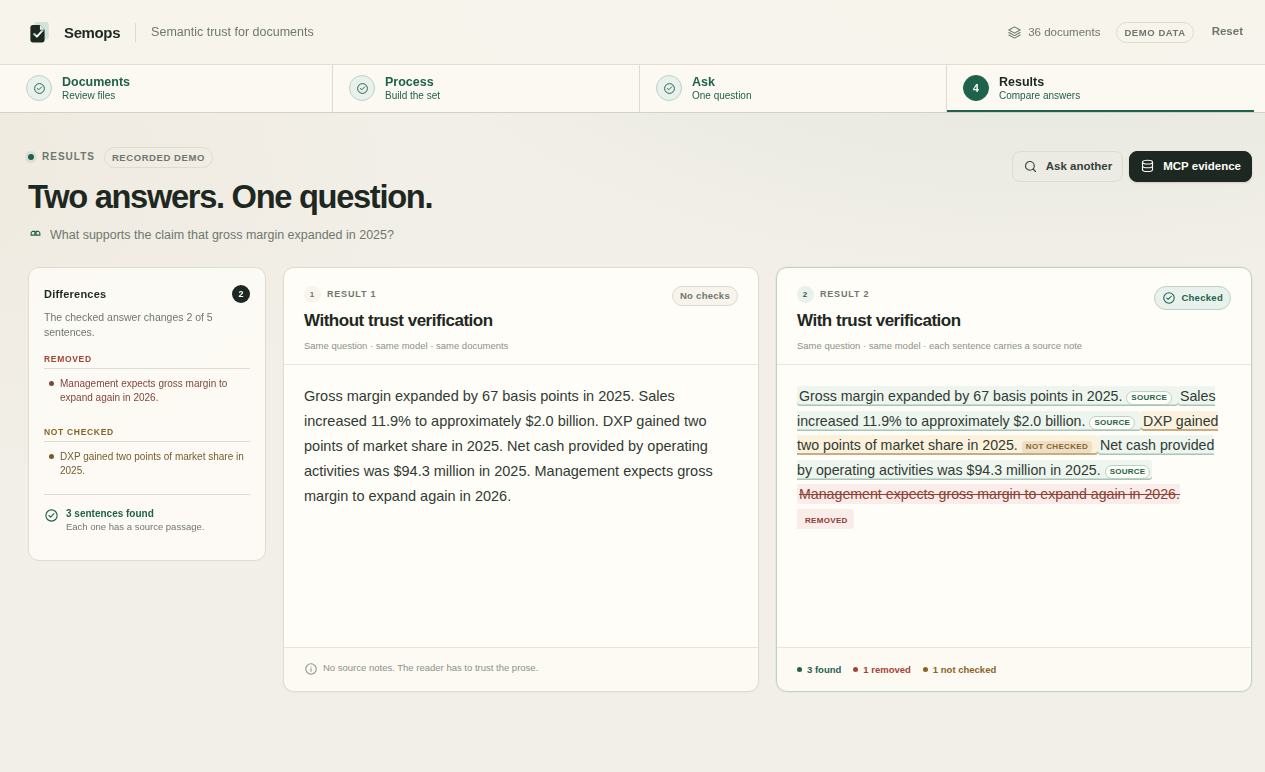
Find the evidence, then check the sentence.
Keyword and semantic search find different things. The pipeline fuses their results at the document level, reranks the surviving candidates, and applies authority and business rules before anything reaches the model.
Each quotation is checked automatically against the retrieved source. A quotation that fails is held for a person and shown as removed, not rewritten into more confident prose. Source IDs, versions, passages, and permissions stay shared across the query model, reranker, gate, and writer; when a silo cannot allow live retrieval, the retrievable layer is precomputed inside the boundary and egress stays aggregate, masked, and limited.
What it shows
An auditable answer, not a confident one.
The recorded screens use synthetic documents; no client documents or identifiers are reproduced. The method draws on earlier applied research; no result from that work is claimed.
Attestation is not entailment. A quotation can be present in the named document and still fail to support the claim around it. The source check makes the quotation traceable, not the argument true.
The sample assessment record applies the same staged annotation and quote-check method to a patient-facing coverage assistant, using public CMS policy and synthetic cases.
Next
Start with the retrieval problem.
Bring one workflow and the sources it depends on. We will scope the retrieval before the model.
Talk through your AI deployment